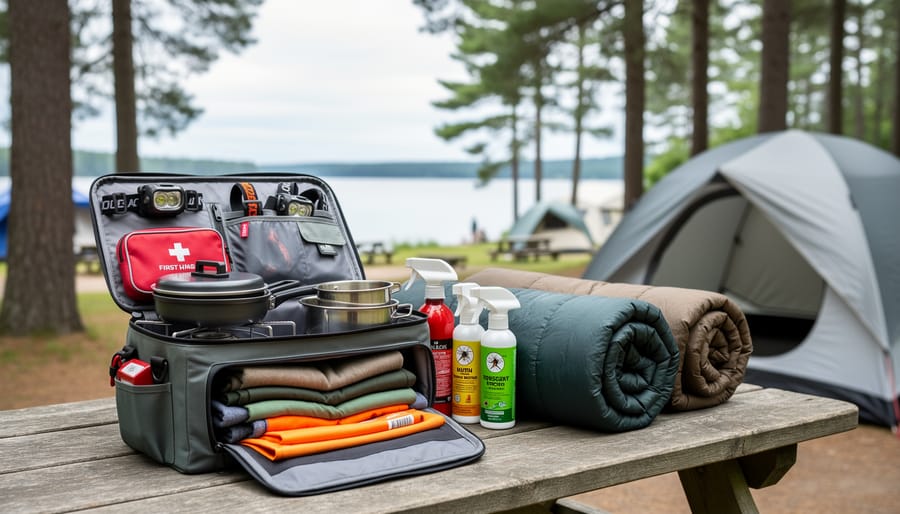
A successful camping trip with friends requires 27 core items across seven categories: shelter and sleep systems, cooking gear, clothing layers, safety equipment, comfort essentials, hygiene supplies, and wildlife protection. The difference between a weekend you’ll talk about for years and a logistical nightmare often comes down to what you remembered to pack and how well your group coordinated beforehand.
Group camping creates unique packing challenges that solo trips don’t. When Sarah Chen and five friends headed to Algonquin Park last July, they discovered they’d brought four lanterns but only one cutting board, and nobody had packed a first aid kit because everyone assumed someone else would. They adapted, but that trip taught them what experienced campers already know: friend groups need both individual essentials and shared gear strategies.
Canadian summer conditions add another layer of complexity. You’re packing for 28°C afternoons and 8°C mornings, sudden rainstorms that blow in off the lakes, and the black flies that make May and June legendary for all the wrong reasons. The good news? Once you understand what to bring and why each item matters for group dynamics, packing becomes straightforward.
This guide breaks down exactly what you need, organized by function rather than a random jumble of equipment. You’ll find specific recommendations tested in real Canadian campsites, from crown land in Northern Ontario to established campgrounds in the Rockies. Whether you’re exploring summer camping ideas for the first time with friends or refining your system after a few trips, you’ll walk away with a clear action plan that prevents both overpacking and those midnight realizations that you forgot something critical.
How We Chose These Camping Essentials
We built this packing list by talking to dozens of Canadian campers who’ve spent summer weekends in the backcountry with their friends. Their stories shaped what made the cut, not just theoretical “nice-to-haves,” but gear that actually solved problems when you’re coordinating multiple people, sharing cooking duties, and keeping everyone safe in the wilderness.
Every item on this list passed through these filters:
- Proven track record from real group camping trips across Canadian parks and Crown land sites
- Solves a specific friend-camping challenge like cooking for 4-6 people or dividing bulky shared gear
- Appropriate for Canadian summer conditions, including cool nights that can drop to 5°C and sudden afternoon storms
- Meets safety requirements for provincial and national parks, particularly in bear country and backcountry areas
- Balances weight and packability with the reality that groups can distribute loads
We also prioritized items that enhance the social experience, because let’s be honest, gathering around a proper camp stove to cook breakfast together beats huddling over individual backpacking burners. The gear here assumes you’re camping during June through September in accessible car-camping or short-hike-in sites, the most common scenario for friend groups exploring places like Algonquin, Jasper, or Fundy National Park. If your trip involves serious backcountry routes or winter conditions, you’ll need to adapt this foundation list with specialized equipment.
Shelter and Sleep Essentials
1. Tents with Adequate Capacity
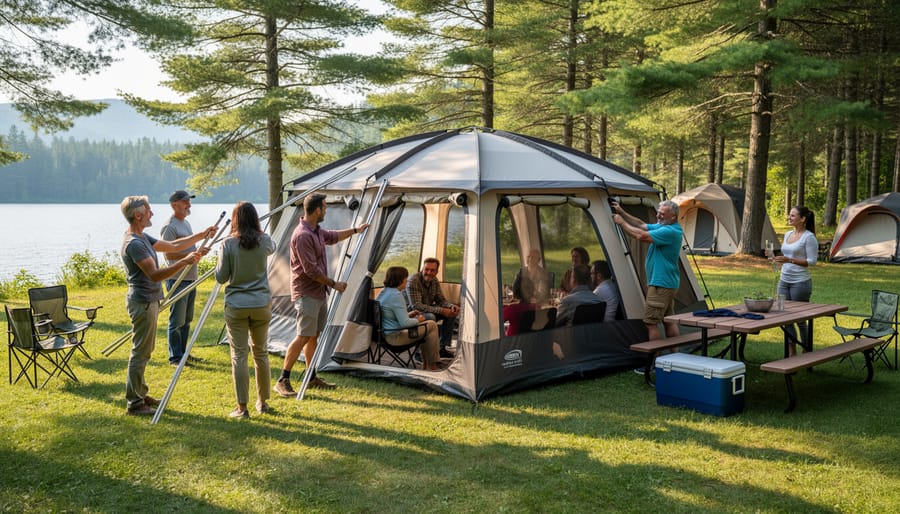
When camping with friends, tent selection goes beyond just fitting everyone inside, it’s about balancing comfort, ventilation, and setup logistics. For groups, bringing 2-3 smaller tents (like 3-4 person models) often works better than one massive shelter. This gives everyone personal space and creates flexibility if friends want different wake-up times or bedtime routines.
Summer camping in Canada demands excellent airflow. Look for tents with mesh panels and dual doors to create cross-ventilation on warm nights. Even in Ontario’s Algonquin Provincial Park, where temperatures can still drop to 8°C overnight, proper ventilation prevents condensation buildup that leaves sleeping bags damp by morning.
A group of friends we spoke with who camp Algonquin annually swears by the “test pitch” approach, they practice setting up all tents together in someone’s backyard before the trip. This saves frustration at the campsite after dark and helps identify if you’re missing stakes or poles. They also coordinate tent placement to create a natural gathering space in the middle, perfect for morning coffee and evening conversations around the fire.
2. Quality Sleeping Bags Rated for Summer
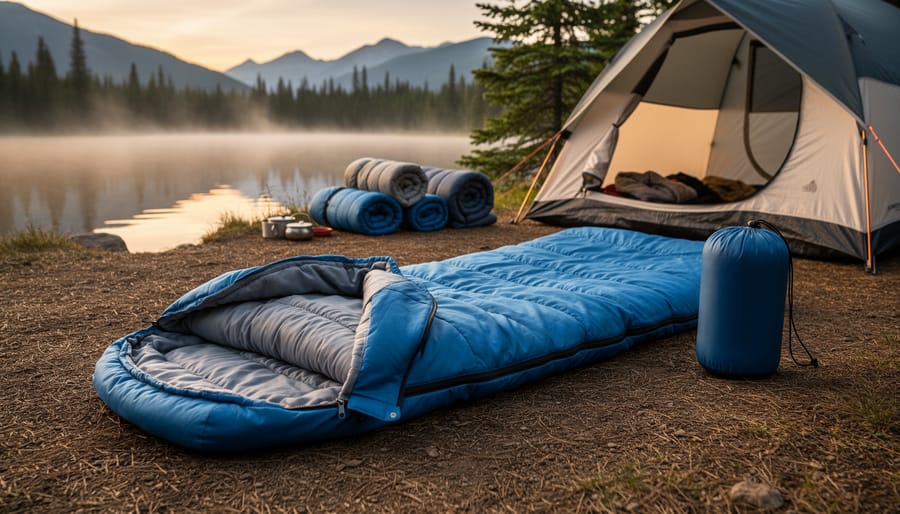
A proper sleeping bag makes the difference between shivering through the night and waking up refreshed for another day of adventure. For Canadian summer camping, choose bags rated for comfort at 5-10°C, summer nights in provincial parks can drop unexpectedly cool, especially at higher elevations or near lakes. Look for models with a comfort rating (not just the lower limit rating) that matches these temperatures, as you’ll likely be sleeping in lighter clothing during social camping trips.
Synthetic insulation works well for summer conditions because it handles moisture better than down if bags get damp from condensation or unexpected rain. Rectangular bags offer more room to move and can unzip fully to use as blankets during warmer nights, while mummy bags provide better heat retention for cooler evenings.
When packing with friends, compression stuff sacks reduce bulk significantly. If you’re staying at campsites with electricity you might consider lighter bags since you’ll have access to vehicle storage and won’t need extreme packability for backcountry hiking.
3. Sleeping Pads or Air Mattresses
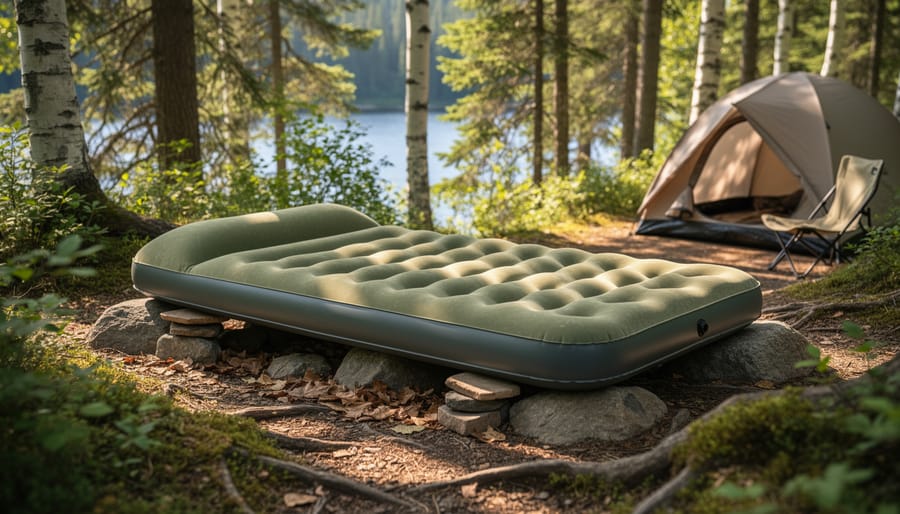
Even in summer, Canadian ground temperatures can sap your body heat and leave you tossing all night on rocks and roots you didn’t notice when you set up. A quality sleeping pad does two jobs: it insulates you from the cold earth and cushions your pressure points so you actually wake up rested enough to enjoy the next day’s adventure with your friends.
For group camping trips, you’ll see a range of choices. Closed-cell foam pads are nearly indestructible, lightweight, and cheap, perfect if you’re hiking in and need to keep pack weight down. They don’t offer much cushion, but they never puncture and work well as emergency sit-pads around the fire. Self-inflating pads strike a middle ground: they pack smaller than foam, provide decent comfort, and take just a few breaths to top off. They’re durable enough for car camping with friends who might accidentally step on gear.
Air mattresses deliver the most comfort and make multi-day trips with your crew far more pleasant, especially if anyone in your group has back issues or isn’t used to sleeping outdoors. The trade-off is bulk and the risk of punctures from tent-floor debris or a misplaced pocket knife. If you go this route, bring a repair kit and test the mattress at home before your trip, nothing kills the group vibe faster than someone spending half the night re-inflating a leaky bed.
Cooking and Food Storage Gear
4. Portable Camp Stove with Multiple Burners
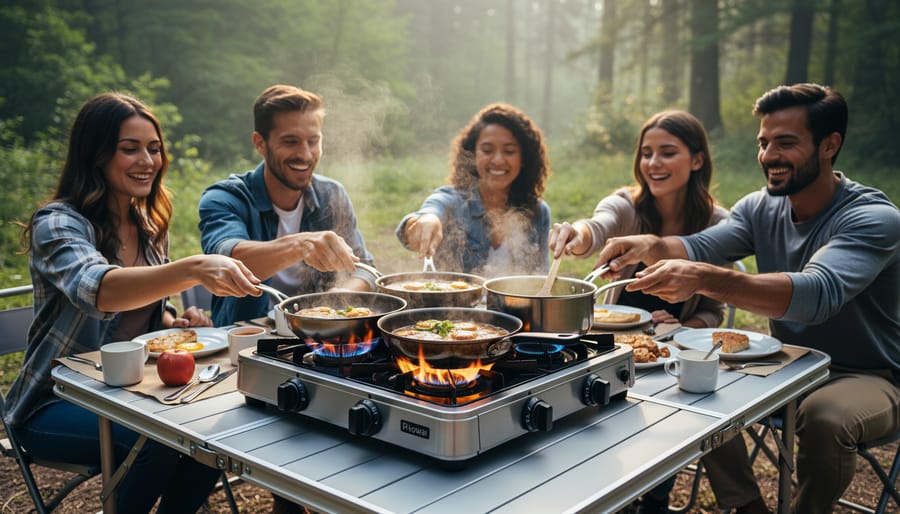
A two-burner camp stove transforms group meal prep from a tedious chore into an efficient social activity. With multiple burners, you can boil water for coffee while simultaneously cooking pancakes or scrambling eggs, essential when you’re feeding four to six hungry campers who all want breakfast at the same time.
For Canadian summer camping, propane stoves outperform butane models in cool morning temperatures. Propane works reliably down to -40°C, while butane struggles below 10°C, those chilly 8°C mornings at 1,400 meters elevation can render butane stoves nearly useless. The canister availability also favors propane across Canadian campgrounds and outdoor retailers.
At Banff’s Two Jack Lakeside campground, a group of friends discovered this efficiency firsthand. Their two-burner Coleman allowed one person to manage bacon and eggs while another heated water for French press coffee and oatmeal. Breakfast was ready in twenty minutes instead of the hour-plus wait they’d endured on previous trips with a single burner. The setup became their morning ritual, with friends rotating cooking duties while others broke down tents.
Look for stoves with wind guards and adjustable heat controls for better fuel efficiency and cooking precision.
5. Cooler with Ice Packs
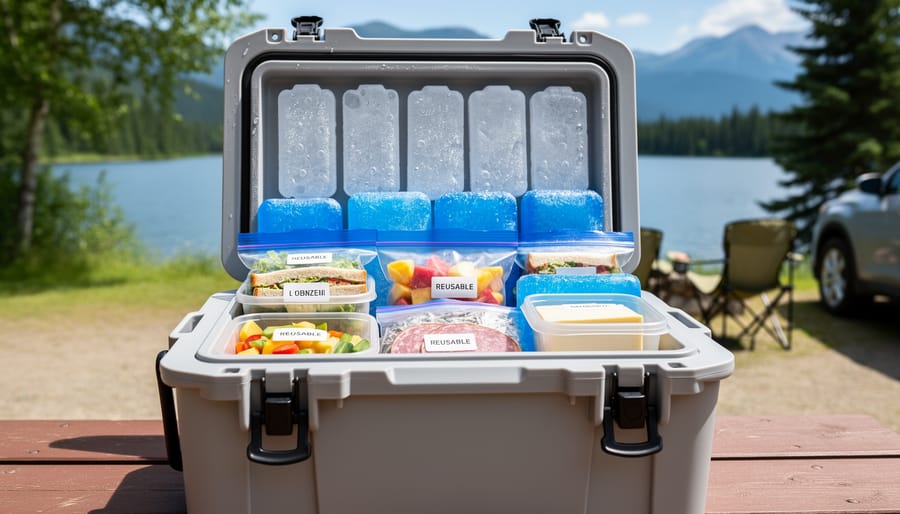
A quality cooler in the 48-70 quart range handles food for 4-6 friends on a typical weekend trip. Larger groups or longer adventures may need multiple coolers, one for perishables and another for drinks to minimize opening the main food cooler. Pre-chill your cooler overnight and freeze water bottles to use as ice packs, which double as drinking water as they melt. Pack raw meat at the bottom where it stays coldest, and layer ice between food items rather than just on top. Block ice lasts significantly longer than cubed ice in Canadian summer conditions.
At bear-active campgrounds across Canada, never leave coolers unattended outside your vehicle. Many parks require hard-sided coolers stored in car trunks overnight, while backcountry sites demand bear canisters for all scented items. Check specific regulations for your destination before packing, Banff, Jasper, and Algonquin all have strict food storage requirements that include coolers. A quality cooler with a tight seal also prevents wildlife from detecting food odours during the day.
6. Cookware Set and Utensils
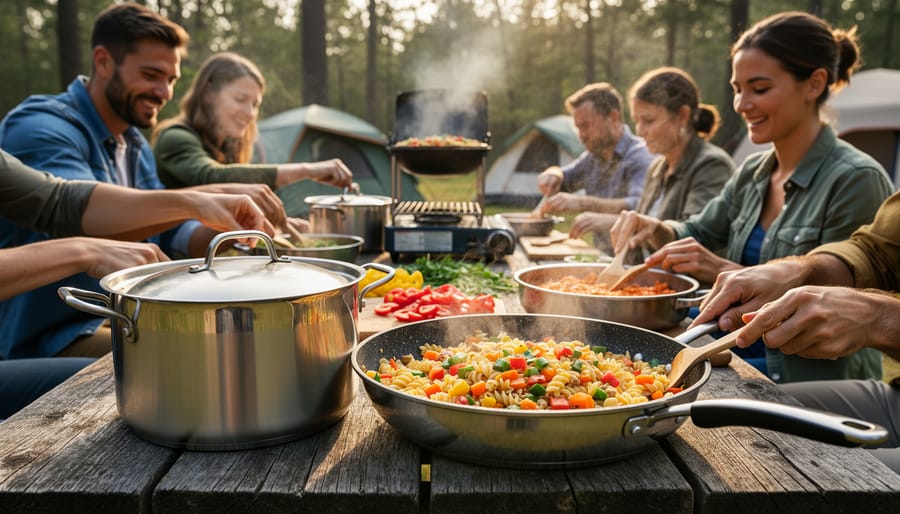
When cooking for a group of friends, you need cookware that can handle larger portions without weighing down your packs. A nested camping cookware set with at least one 2-3 litre pot and a 10-inch frying pan gives you the capacity to prepare meals for four to six people efficiently. Look for hard-anodized aluminum or titanium options that distribute heat evenly while remaining lightweight, critical when you’re hiking to backcountry sites.
Before your trip, designate cooking roles among your group: who handles breakfast prep, dinner cooking, and cleanup rotation. This prevents the “too many cooks” problem and ensures everyone contributes. Pack a spatula, long-handled spoon, and tongs that can handle high heat from camp stoves. Include a small cutting board and a sharp knife in a protective sheath.
Cleaning becomes easier when someone brings a collapsible basin for washing and another for rinsing. Many Canadian campgrounds have minimal facilities, so you’ll need to scrape food scraps into trash bags, wash with biodegradable soap away from water sources, and pack a scouring pad for stubborn residue. One camper trick: bring a small bottle of olive oil to coat pans before cooking, it prevents sticking and makes cleanup significantly faster when you’re tired after a full day of activities.
7. Reusable Plates, Bowls, and Cutlery
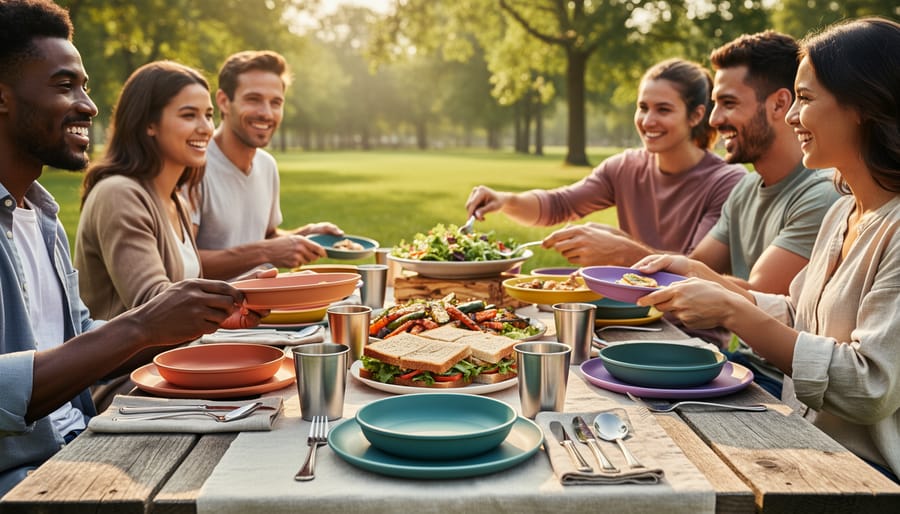
Disposable plates might seem convenient, but they create unnecessary waste in Canada’s pristine wilderness areas and add bulk to your trash bags. Invest in a set of lightweight reusable dishes instead, melamine or enamelware plates hold up well to campfire cooking and won’t crack if someone drops them during cleanup. Look for nesting bowl and plate sets that stack together to save precious pack space. Each person should bring their own spork or cutlery set; carabiner-clip utensil kits attach easily to backpacks and prevent the “whose fork is this?” confusion. Most Canadian parks now emphasize pack-in, pack-out principles, and reusable dishware means less garbage to haul home after a weekend with friends. Rinse plates thoroughly before washing with biodegradable soap at designated areas, and store them in a mesh bag so they air-dry overnight.
8. Water Bottles and Filtration System
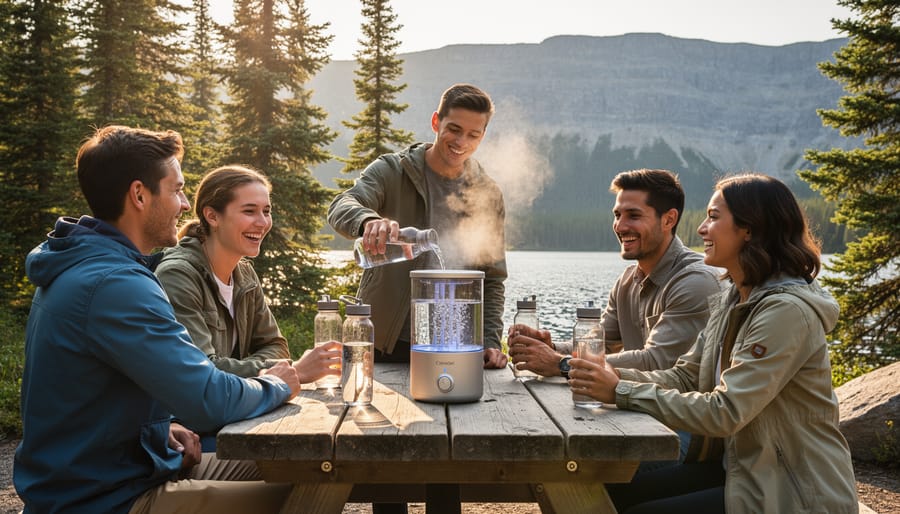
Plan for at least 2 litres of water per person per day for drinking, plus extra for cooking and cleaning when camping with friends. Individual reusable water bottles, one per person, are essential, but bringing a shared group filtration system makes refilling practical at backcountry sites without hauling excessive weight.
For Canadian wilderness water sources, treat all lake, river, and stream water before drinking. Giardia and other pathogens exist even in pristine-looking alpine lakes. Pump filters work well for groups since you can quickly fill multiple bottles, while gravity filters let you process larger volumes hands-free at camp. UV purifiers like SteriPEN are lightweight backup options but require clear water and battery power.
Coordinate filtration duties on a rotation so one person isn’t always stuck pumping water while friends relax. Designate a “clean” collection area at camp to avoid cross-contamination, and remind everyone to keep their personal bottles clearly marked, nothing worse than grabbing the wrong bottle after someone’s been drinking river water all day.
Clothing and Personal Items
9. Moisture-Wicking Base Layers
When you’re hiking to a remote campsite or gathering firewood with friends, moisture-wicking base layers pull sweat away from your skin to prevent that clammy discomfort that cotton creates. Synthetic fabrics like polyester or natural merino wool dry remarkably fast, essential when someone suggests an impromptu swim in a Canadian lake or you get caught in an afternoon shower. These layers also regulate temperature as activity levels shift throughout the day, keeping you warm during cool mornings around the fire and comfortable during midday hikes. Pack at least two sets so you have a fresh layer while the other dries on your tent line.
10. Insulating Mid-Layer and Rain Jacket
Even on warm July afternoons, Canadian summer evenings can drop to 8-12°C, especially near lakes or at elevation. An insulating mid-layer like a fleece or lightweight synthetic jacket bridges the gap between your base layer and rain shell. Choose something compressible that stuffs into a daypack corner without taking up valuable space your friends need for shared snacks and gear.
For rain protection, understand the difference: waterproof jackets (10,000mm+ rating) handle sustained downpours during surprise storm systems, while water-resistant shells work for light drizzle but will eventually soak through. Check real-time camping tools before your trip to anticipate weather patterns, but always pack for worst-case scenarios. A packable rain jacket with pit zips prevents overheating during active hiking while keeping you dry. These two layers work together as your temperature regulation system, letting you adapt quickly when conditions shift without slowing down the group.
11. Sturdy Hiking Boots or Trail Shoes
Proper footwear can make or break a camping trip, especially when you’re exploring Canadian trails with friends. Choose hiking boots with ankle support for rocky, uneven terrain common in provincial and national parks, or opt for trail shoes if you’re sticking to well-maintained paths and prefer lighter weight. The key is breaking them in at least two weeks before your trip, blisters slow down the entire group and turn what should be an enjoyable hike into a painful slog. Pack a second pair of camp shoes like sandals or lightweight sneakers for wearing around the campsite. Your feet will thank you after a long day on the trails, and you’ll keep your tent cleaner by leaving muddy boots outside.
12. Sun Protection Essentials
Canadian summer sun is surprisingly intense, especially at higher elevations and when reflected off water during lake activities. Pack broad-spectrum sunscreen with SPF 30 or higher, choose reef-safe formulas if you’re swimming in pristine lakes to protect aquatic ecosystems. A wide-brimmed hat shields your face and neck during hiking and campsite activities, while polarized sunglasses reduce glare from water and prevent eye strain. UV rays penetrate cloud cover, so apply sunscreen even on overcast days. At elevations above 1,000 meters, UV exposure increases by roughly 10 percent per thousand feet, making reapplication every two hours crucial during alpine camping trips with friends.
Safety and Navigation Tools
13. First Aid Kit
A comprehensive first aid kit is non-negotiable when camping with friends in Canadian wilderness areas. While individual campers might carry basic supplies, a group-sized kit should contain enough materials to handle multiple minor injuries and at least one moderate emergency until professional help arrives.
Your kit needs to address the most common camping injuries: blisters from hiking (moleskin, blister pads, and athletic tape), cuts and scrapes (various bandage sizes, sterile gauze, antiseptic wipes), and burns from campfires or cooking (burn gel, non-stick dressing). Include tweezers specifically for tick removal, since blacklegged ticks carrying Lyme disease are increasingly common in Ontario, Quebec, and parts of the Maritimes. Pack pain relievers, antihistamines for allergic reactions to plants or insect stings, and anti-diarrheal medication.
Each person should bring their own prescription medications plus a few days’ extra supply. Designate one friend as the group’s first aid coordinator who knows where supplies are stored and has basic training in wilderness first aid. Restock your kit after each trip and check expiration dates on medications before heading out, especially if you’re reusing supplies from last season’s adventures.
14. Navigation Tools (Map, Compass, GPS Device)
Getting lost with friends sounds fun until you’re actually trying to find your way back to camp at dusk. Even if you’re staying at established campgrounds in Canadian parks, bring proper navigation tools, cell service is spotty or nonexistent in most wilderness areas, and your phone battery won’t last a multi-day trip.
Pack a physical topographic map of your area (available from Parks Canada or provincial park offices), a reliable compass, and consider a GPS device as backup. Download offline maps to your smartphone before you leave, apps like Gaia GPS and AllTrails work without cell towers. Designate one person to lead navigation, but teach everyone basic map reading so the group isn’t helpless if you get separated on a trail. Understanding contour lines, knowing how to take bearings, and recognizing landmarks builds confidence and keeps everyone safer during side hikes from your base camp.
15. Headlamps and Flashlights with Extra Batteries
Every person in your group needs their own headlamp, not just one shared flashlight. When someone needs to find the bathroom at 2 a.m. or dig through their pack after sunset, they shouldn’t have to wake the entire campsite asking to borrow light. Headlamps keep your hands free for setting up tents, cooking dinner, or reading in your sleeping bag.
Look for models with red light mode, which preserves your night vision when you’re stargazing or moving around camp without blinding your friends. A minimum 200-lumen output handles most camping tasks, though brighter settings help on trail walks after dark.
Pack extra batteries for everyone, cold Canadian nights drain power faster than you’d expect, and multi-day trips mean you can’t just recharge at home. Bring at least one backup set per headlamp, plus a spare handheld flashlight for the group as emergency backup.
16. Multi-Tool or Knife
A quality multi-tool or fixed-blade knife is one shared item every group should pack, you’ll reach for it constantly throughout your trip. Beyond obvious uses like slicing food and opening packages, a good multi-tool handles unexpected repairs to tents, backpacks and gear that would otherwise cut your adventure short. The knife component tackles firewood kindling and rope cutting, while pliers, screwdrivers and scissors solve problems you didn’t anticipate. For Canadian parks, blade regulations vary by province: most allow fixed blades under 4 inches for camping purposes, but concealed carry or automatic knives face restrictions. Provincial parks generally permit standard camping knives, while urban park regulations differ. One person carrying the group’s multi-tool keeps it accessible and prevents loss, just establish a “knife keeper” role each day so everyone knows where to find it when someone needs to repair a tent pole or prep vegetables for dinner.
Camp Comfort and Entertainment
17. Portable Camp Chairs
Portable camp chairs transform evenings at the campsite from sitting on logs or the ground to actual comfort while your group shares stories around the fire. When camping with friends, chairs become social hubs, everyone gravitates to the circle of seats for meals, card games, and those late-night conversations under the stars.
For summer camping trips, you’ll find two camps: ultralight folders that pack down to water-bottle size (around 1-2 pounds) and sturdier models with armrests and cup holders (4-6 pounds). The lightweight versions work well if you’re hiking to your site, but they sacrifice back support. Heavier chairs offer genuine comfort for extended sitting, which matters when you’re lingering over dinner or watching the fire die down.
A group of friends camping at Jasper National Park last summer brought a mix of both styles. The hikers appreciated their compact chairs during the trek in, but after dinner, everyone migrated to the two deluxe models with padded backs. Their solution for future trips? Each person brings a lightweight chair, plus the group splits carrying two comfort chairs as shared gear.
Bring one chair per person minimum. Sharing sounds feasible until someone wants to sit while others are hiking, and musical chairs gets old fast around the campfire.
18. Camping Table
A portable camping table transforms your campsite into a functional social hub where friends can gather for meals, late-night card games, and morning coffee without hunching over coolers or balancing plates on their laps. Beyond comfort, tables provide a clean, elevated surface for food prep, crucial when cooking for a group and trying to keep ingredients organized and free from dirt, pine needles, and curious chipmunks. They also create a dedicated space for camp activities: spreading out maps during trip planning, playing board games during afternoon downtime, or setting up a wilderness bar for cocktail hour.
Look for tables with adjustable height settings that work for both standing food prep and seated dining. Lightweight aluminum models weighing 10-15 pounds fold into compact carry bags, while heavier roll-top designs offer more stability in windy conditions. Consider surface size based on your group, a 32×32 inch table comfortably seats four for cards, while longer rectangular tables accommodate group meal service.
19. Firewood and Fire Starters
Purchase firewood at or near your campsite rather than bringing it from home, the don’t move firewood principle protects Canadian forests from invasive insects and diseases that hitchhike in bark and wood. Most campgrounds sell bundles on-site, or you’ll find vendors within 50 kilometres of popular parks. Bring reliable fire starters, waterproof matches, a butane lighter, and commercial fire starter cubes or natural fatwood, because damp wood is common after summer rainstorms. Check current fire restrictions before you go; many parks issue bans during dry periods, and some sites prohibit ground fires entirely, requiring you to use designated fire pits or elevated fire pans.
The campfire anchors your evening routine with friends: cooking bannock on sticks, roasting marshmallows, swapping stories under the stars. It’s where conversations deepen and the day’s hiking blisters become funny anecdotes. Assign one person as fire tender each night to keep it safe and properly extinguished, dousing with water until cool to the touch, so the group shares responsibility and everyone learns proper technique.
20. Games and Activity Gear
Downtime at camp creates some of the best memories with friends, and the right entertainment gear turns quiet moments into laughter-filled evenings. Pack a waterproof deck of cards for rainy afternoons in the tent, games like Euchre and Cribbage are Canadian camping classics that never get old. A frisbee or football weighs almost nothing but provides hours of fun on open campground fields. Consider compact travel versions of board games designed for outdoor use, or bring a nature identification guide to turn wildlife spotting into a friendly competition. If your group enjoys fishing, lightweight rods can add another dimension to lakeside camping. The key is choosing activities that work without screens or electricity, encouraging genuine connection while you’re surrounded by Canadian wilderness. Most campers find that simple, interactive games beat elaborate entertainment every time.
21. Camera or Smartphone for Photos
Most friend camping trips create photo opportunities you’ll want to capture, sunrises over lakes, group shots around the campfire, or unexpected wildlife encounters unique to Canadian wilderness. Your smartphone likely serves as your primary camera, but preparing it properly for outdoor conditions prevents missed moments and dead batteries.
Bring a waterproof case if you’re paddling, swimming, or camping during rainy periods. A good case protects against drops on rocky trails and splashes during canoe trips. Portable chargers are essential for multi-day trips since campgrounds rarely offer convenient charging access. Pack at least one 10,000mAh power bank per person, or share a larger 20,000mAh unit among close tentmates.
Battery drain accelerates in cold Canadian nights and when using GPS features during hikes. Enable airplane mode when you don’t need service to conserve power. If someone in your group has a dedicated camera, coordinate who’s capturing what moments to avoid everyone shooting identical photos while draining all devices simultaneously.
Hygiene and Sanitation Items
22. Biodegradable Soap and Towels
Switching to biodegradable soap protects the lakes and streams you’re enjoying during your camping trip. Regular soap contains phosphates and chemicals that harm aquatic ecosystems, which matters especially in Canada’s pristine wilderness areas. Look for concentrated camp soap labeled biodegradable that works for dishes, hands, and body washing, one bottle shared among friends saves pack space.
Pair your soap with quick-dry microfiber towels that wring out easily and dry overnight even in humid conditions. These compact towels take up minimal room compared to cotton options and won’t stay damp and musty through your trip.
Proper greywater disposal means washing dishes at least 70 meters from any water source. Strain food particles into your trash bag, then scatter soapy water widely over soil or gravel where natural filtering occurs before it reaches groundwater. Many Canadian campgrounds provide designated dishwashing stations, use them when available to minimize environmental impact.
23. Toilet Paper and Trowel
When nature calls in the backcountry, you’ll need unscented toilet paper and a lightweight trowel. At established campgrounds with pit toilets or flush facilities, you’re set, but wilderness camping requires more preparation. Dig cat holes 15-20 centimetres deep and at least 70 metres from water sources, trails, and campsites. In high-use areas like parts of Banff or popular Algonquin sites, pack out all toilet paper in sealed bags to prevent accumulation. Coordinate bathroom locations with your group to avoid overlap and maintain everyone’s comfort. A small camp trowel weighs almost nothing but makes a significant difference in following Leave No Trace principles and protecting Canadian wilderness for future campers.
24. Hand Sanitizer and Wet Wipes
Hand sanitizer becomes your best friend when you’re prepping meals for a group at a remote campsite without running water nearby. Keep a small bottle clipped to your backpack and a larger pump bottle at your cooking station, you’ll use it constantly before handling food, after touching firewood, and when multiple people are sharing utensils and serving dishes. Wet wipes serve double duty for quick hand cleaning and wiping down cooking surfaces between meal prep sessions.
Choose unscented products to avoid attracting curious wildlife to your campsite. Scented wipes smell appealing to bears and other animals, especially citrus or floral fragrances. Pack enough for your entire group, budget roughly 10-15 wipes per person per day for a weekend trip. Store used wipes in a sealed plastic bag with your other trash rather than tossing them in the campfire, as they don’t burn cleanly and leave residue.
Bug Protection and Wildlife Awareness
25. Insect Repellent and Bug Net
Canadian summers bring spectacular weather and relentless insects. From late May through August, mosquitoes and blackflies peak across most provinces, with Ontario cottage country and northern regions particularly intense. Pack DEET-based repellent (30% concentration works well for most campers) alongside natural alternatives like picaridin or lemon eucalyptus oil for friends with sensitive skin. Head nets become essential during peak bug season, they weigh almost nothing and transform miserable trail experiences into tolerable ones.
Consider treating one set of clothing with permethrin before your trip. This insecticide bonds to fabric fibers and repels mosquitoes and ticks for multiple washes, offering protection without constant reapplication. Apply it outdoors 24 hours before packing.
Sarah’s group learned this lesson camping near Algonquin in July. “We showed up with one can of spray between six people,” she recalls. “By sunset, we were hiding in tents while bugs swarmed outside. Someone drove to town for reinforcements.” Now her crew packs individual repellent bottles and keeps backup nets in shared gear. Many national parks free entry periods coincide with bug season, so come prepared to enjoy those savings without the itch.
26. Bear-Proof Food Storage or Rope
Proper food storage isn’t optional in Canadian wilderness, it’s a safety requirement that protects both your group and local wildlife. Most provincial and national parks mandate bear-proof storage, but the specific method varies by location.
Bear canisters offer the most reliable protection. These hard-sided containers are required in parks like Banff and Jasper backcountry, where you’ll rent them at visitor centers if you don’t own one. For group trips, calculate one canister per two people for weekend outings, more for longer adventures. The advantage? No trees needed, and setup takes seconds after a long hike.
Food hanging remains acceptable in many Ontario and Quebec parks where suitable trees exist. You’ll need 50 feet of lightweight rope and a stuff sack. The proper technique: locate two trees 20 feet apart, toss the rope over branches at least 15 feet high, and suspend your bag at least 12 feet off the ground and 6 feet from tree trunks.
Coordinate with your friends before the trip, assign one person to bring the canister or rope, and designate a storage leader who ensures everything scented (toiletries, sunscreen, lip balm, even that emergency chocolate bar in someone’s jacket pocket) gets secured each night.
27. Bear Spray (if in Bear Country)
Bear spray isn’t optional if you’re camping anywhere in the Canadian Rockies, northern British Columbia, or most of Alberta and Saskatchewan’s backcountry. Parks Canada requires it in places like Banff, Jasper, and Yoho, and for good reason, black bears and grizzlies are active all summer. Each person in your group should carry their own canister (around $50-60) on their belt or chest holster, not buried in a backpack. Before the trip, watch a safety video together so everyone knows the proper stance, wind direction check, and that you aim low in a cloud pattern if a bear charges within 7-10 metres. Check specific park regulations beforehand; some provincial parks recommend it strongly while federal parks in bear country mandate it.
Packing Smart for Group Camping Success
The difference between a chaotic camping trip and a smoothly-run adventure often comes down to coordination before anyone leaves home. Schedule a pre-trip planning meeting where your group can divide shared items like tents, cooking gear, and coolers. Assign one person to handle the stove and fuel, another to coordinate the cooler and ice packs, and distribute bulky items like the camping table across multiple vehicles. This prevents gear duplication and ensures nothing critical gets left behind.
Weight distribution becomes crucial if you’re hiking into your campsite. Distribute heavier shared items like food, water filtration systems, and cookware evenly among the group based on fitness levels and pack capacity. Someone carrying the tent shouldn’t also haul the cooler contents and firewood.
Create a master checklist using a shared document where friends can mark off their assigned items as they pack. Include a “personal responsibility” section covering individual sleeping bags, clothing layers, and headlamps alongside the communal gear list. This transparency helps everyone see what’s covered and what’s missing.
When you’re ready to reserve your campsite the Canadian Forest Camping platform lets you filter for group-friendly sites with amenities that match your needs, whether that’s multiple tent pads, proximity to water sources, or bear-proof food lockers already installed. Proper preparation transforms packing from a stressful scramble into a collaborative effort, leaving you more time to enjoy summer nights around the campfire with friends who actually remembered to bring the marshmallows.
Frequently Asked Questions
How do we split costs for shared gear when camping with friends?
The fairest approach is to create a shared spreadsheet before the trip listing all communal items (tents, cooking gear, coolers, firewood) with their costs, then divide the total by the number of participants. One person can purchase shared items and get reimbursed, or you can assign different categories to different friends and settle up before you leave for the campsite.
What’s the best way to coordinate meal planning for group camping?
Assign each person or pair to lead one meal (breakfast, lunch, or dinner) including planning, shopping, and cooking for that meal. This distributes the work evenly and lets people showcase their camp cooking skills while ensuring everyone contributes equally to the food budget and preparation.
How much should each person carry on a hike-in camping trip?
A general rule is 20-25% of your body weight for experienced hikers, but for social camping trips with mixed fitness levels, aim for 15-20% and distribute heavier shared items (tents, cooking gear) among the strongest hikers. Everyone should carry their own sleeping bag, pad, clothes, and a portion of the group food supply.
What if someone forgets essential items at home?
Build redundancy into your group packing by having at least two people bring critical items like first aid kits, fire starters, and water filtration. For personal gear like sleeping bags or rain jackets, nearby outdoor shops in popular camping areas often rent equipment, though this adds unexpected cost.
Are group permits required at Canadian campgrounds?
Most provincial and national park campgrounds in Canada don’t require special group permits if you’re booking standard campsites, but group camping areas (which accommodate 10+ people in a single site) do require advance reservations and sometimes have minimum night stays. Always check the specific park’s website when booking, as some backcountry areas limit group size to 6-8 people per site.
These practical considerations come up on nearly every friend camping trip, so addressing them before you hit the road saves confusion later. The most successful group camping experiences happen when everyone knows their responsibilities, the gear is fairly distributed, and you have backup plans for the inevitable forgotten item or weather curveball.
Communication before departure makes the difference between a smooth adventure and a stressful scramble. Set up a group chat a week before the trip to confirm who’s bringing what, share the meal plan, and review the campground rules together. That preparation time lets everyone ask questions, flag concerns about gear they don’t own, and get excited about the upcoming adventure in Canada’s summer wilderness.